


Ghich Pich @ NLS: A Conversation about Law School, Start-ups, and Films
- Quirk NLS
- Jul 30, 2025
- 39 min read

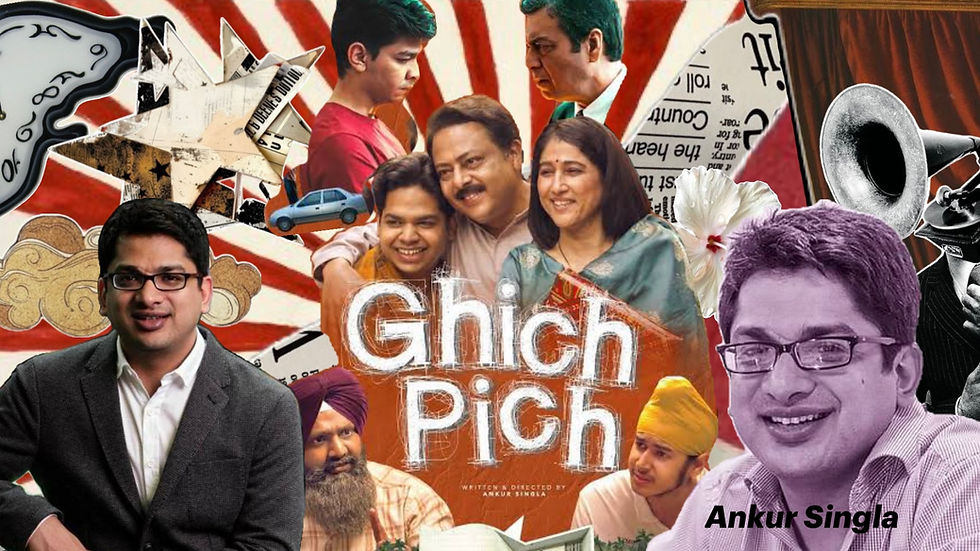
CulComm and NLS Film Collective conducted an interview with Ankur Singla, an NLS alumnus from the 2007 batch. Ankur is the founder and CEO of a company, Stir, that connects filmmakers, producers, and movie studios with vetted influencers. Ankur is also a screenwriter and director, who finished his first feature film ‘Ghich Pich’, which will hit the theatres on 1st August. ‘Ghich Pich’ is a coming-of-age, indie film that took 4.5 years to make. The film will be in theatres on August 1st, 2025
The Quirk Team has transcribed the interview. Read more to gain insight into Ankur Singla's #AltCareers.
Aishiki:
Ankur started off just like many of us. He [did] moots, co-founded the OG Film Club, and even landed a gig at Linklaters in London. But his journey did not stop at law firms. He went on to build Tapzo, a startup he later sold to Amazon. Today, he is the founder of Stir, a platform connecting filmmakers with influencers, and most excitingly, he's just finished his first feature film Ghich Pich, releasing this August. Ankur is here to chat with us about his time at law school, his journey through startups, and how he ended up writing and directing films. Please join me in welcoming him today.
Vansh:
Okay, hi, so the movie's titled, Ghich Pich. What inspires the title of the movie? Where does the title come from?
Ankur:
So, can I just give a quick background ki ye hua kaise before we get to that question? So, I graduated in 2007 as she said, and I worked at Linklaters for about one year, nine months, [before] I quit. I didn't enjoy it too much. I came back to India, and I started a startup in 2009 before it was that common, learned coding, figured out how to hire a tech guy, etc, and built a tech company. We did a couple of pivots, and then we sold the company to Amazon. So, mai Amazon mei tha, we sold the company in around 2018 and [in] 2020, Covid came. And when Covid came, I was, anyway, in a kind of mental state ki kuch aur karna hai, and I have to do something creative as well. But because of law school and other things, I had always seen myself as a very left-brained person, ki I don't have creative ability. Toh Amazon, may they give us a test which is called growth mindset. Growth Mindset, it's probably a corporate term. It kind of is a list of questions which assesses whether you have a growth mindset or a fixed mindset. Toh usme question tha, “can you become a cricketer at 35 and become part of the Indian cricket team?” Tab uska answer likhna tha aapko yes or no. Kuch galat sahi nahi hai, you just have to answer. And maine kaha nahi yaar, it's not possible. So, I marked it as no. My CTO was sitting next to me, [and] he marked it as yes. I was like, ye kaise? [Voh] kehta hai, “yaar ho sakta hai, kuch bhi ho sakta hai.” You know, like, you can do it. And that's when, it started getting triggered in my mind, that maybe creativity is also possible. So, I went for film classes here in Bangalore. There was a weekend film course. They taught us screen writing; they taught us directing. And we have to make… So sabse pehle when they teach, even in FTII, if you guys are familiar with the film course, they make you shoot a one-minute film, which is without any cuts. So, you have to shoot something in one minute. Then they give you an assignment to shoot a three-minute film, but you have to make 90 cuts in it. So, you have to cut every few seconds, so that there are 90 cuts overall in the film. Then they tell you to make a five-minute film, and then they tell you to make a 20-minute film. Ye abhi you see the final feature film. Behind all of that was this film course, which, you know, you pick up the ropes and so on. And then I did that, and then the time came to write a script. And in Covid, you know, mentally, a lot of things were happening, and that's where the title comes from-- Ghich Pich. I didn't exactly have an idea what to write about. So, I just wrote whatever I was feeling and finally I gave it the title Ghich Pich. The reason it's also called Ghich Pich is because I did not have a concrete theme when I was writing. It was basically separate anecdotes of multiple things that had happened, which is not a great way to write a screenplay, but that's how I wrote the first version, and that's why it was called Ghich Pich.
Aishiki:
Ankur, you also founded the OG Film Club at NLSIU. So, was there ever a moment that you realized that law wasn’t for you? Or was all of this always a parallel dream all along?
Ankur:
Film was never part of the plan. It was like dekh lo, you can appreciate world cinema. We used to play all these, I was talking to Dhruv, right? Yeah, I was telling him we used to screen all these French New Wave, Italian Neorealism itna kuch humne screen kiya, koi aata nahi tha. Hum 5-6 Film Club ke members dekh lete the, on a big screen. But we did a Amitabh Bachchan weekend, and we got some 50-60 people to come and attend. Nothing has changed, it seems. But, yeah, it was never part of the plan. It happened in Covid. I used to love films but never thought I could write and direct.
Aishiki:
Also, I think, in a time where cinema is either going hyper commercial or hyper political, where does Ghich Pich place itself?
Ankur:
You know, that's a very good question. Even when I was writing, there's a very clear divide between the typical indie film, which is very political, you're out there to say something. Or there is commercial [cinema]. You know, cinema is also the only art form which is so commercial, [since] you end up spending a lot of money that can only be recovered if you do something commercial. So, on the left-hand side, you have these people who only survive on grants and make good indie films. And on this side, you have you have to cater to the mass audiences. Obviously, with OTT, they fund some of that. Ghich Pich is somewhere in the middle, because I kind of didn't really relate to either of the two sides. Like, I've been to many film festivals. I went to Cannes a couple of years [ago]. Last year, I think. [It is] very difficult to sit through some of the films. They are great films, but vo meri liye bhi boring thi. Aur idhar wali (mainstream films) toh dekhi hi nahi jaati. I have not been to, like, one of these mainstream films. It's not like my cup of tea. So, it's very much in the middle, and it is both an advantage and a disadvantage, because you kind of have a best of both worlds, and you kind of lose out on both sides. So theek hai, but you have to do what you really want to write and what you want to say.
Meera Nair had a great quote. Meera Nair, everybody’s heard of? A lot of people are blank, but Meera Nair directed Monsoon Wedding, Namesake. She's one of great Indian film directors. She has a very nice quote that says, “If you don’t tell your story, then who will,” and that's a very good encouragement to a first-time writer. My wife is a writer. She's also my batchmate from NLS. She wrote a fiction book which is published by Harper Collins. So, you know, law jo karte hain unme kaafi keeda hota hai, at least fictional novel ka toh bohoto mei hai. Humare batch mei se, I think 4-5 log ek fiction book toh likh chuke hain. And it's not very dissimilar that you should write about what you know, and that's good advice for young people or first-time writers. So that's what I did, and it happened to be somewhere in the middle. And yeah, that's it.
Vansh:
So what was the process you followed as per the script writing? Did you use a storyboard, or did you use a beat sheet? Or was it a synopsis?
Ankur:
Yeah. So, you know, basically they say that you first write a three page or a five page story, then you write a scene treatment. So, scene treatment is roughly, agar 90 minutes ki film hai aapka ek scene ka average two minute, give or take. If it's Mission Impossible, it'll be shorter. You know how it is. So aapko 45 scenes likhne hain, so you write over eight pages, 45 scenes ki summary. So one, one para—iss scene mei ye hoga, phir ye hoga, and then you write a 90-page or a 100-page script. So, I followed that, more or less. That's what a teacher had also told us. I kind of jumped directly to the scene treatment, because dimaag mei directly, you know, some scenes and shots and visuals present themselves. Dialogues come to your head. So, I wrote a scene treatment, and then I wrote a full screenplay. You guys are familiar with the screenplay?
Ye sab mere liye bhi naya tha, it was pretty exciting. Filme sabko acchi lagti hain but chalo bann ke aa gayi toh you just watch it. Screenplay mei, do you guys all know about three act structure? I'm just assuming things because they are a bit obvious. So, three act structure is the beginning, middle, and end, right? Very simple. You have to have a beginning, you have to have a middle, you have to have an end. Even if you do not have it, it will come on its own. But, there is a method to doing the beginning, middle, and end. The beginning is called a setup. So you set up the characters, you set up their story, you set up their world. And the beginning is supposed to kind of end at a point where a conflict starts or an inciting incident starts. Inciting incident means ab kuch hua. Now this is going to be what the character is going to chase for the rest of the film. The middle part is the part where his journey becomes more and more complex. And third part is the part where this journey resolves. That's the scheme. Now, if you look at any film, it will be the same. All filmmakers and screenwriters are trying to establish a conflict within the first 15 minutes of the film. Comedy bhi dekhi hogi, usme bhi yahi follow hota hai. Character jaa raha hai, khush hai, sab kuch achcha hai, or a boy meets girl bhi ho raha hai, and then at about 15-to-20-minute mark, kuch aisa hua ki unki zindagi ekdum… the world will go apart, and then they will start figuring out the solution. So, you have to have a beginning, middle and end. So, when you write the script and the scenes, you have to make sure that the first, you know, seven-eight, or maybe 10-12 scenes are covering [this].
Anything that you want to have in the third act or in the final resolution, must be there in the first act. So, there's a thing in screenwriting, which is, if a gun goes off in the third act, it must be there in the first act, right? So, agar aapne end mei kuch bhi kiya toh yaha pe aapko establish karna hai. If a screenplay doesn't work, it is usually because aapne shuru mei usko theek se establish nahi kiya, right? So for example, let's say somebody is very scared of monsters, and by the end of the film, they have to overcome their fear. The fear of monsters has to be established very clearly in multiple different ways in the beginning. So that's what you follow in screenplay writing. Screenplay 90-minute ka hota hai. One page of a screenplay is equal to one minute of movie time, roughly. So, 90 pages, 90 minutes of film. So that's how typically screenplays are written. And yeah, then you write it, and then you rewrite, and you rewrite and you rewrite. So, this film would have gone through about 35-40 rewrites. So, a lot of rewriting! Screenplay is mostly rewriting and very, very painful and very difficult also to write it. Abhi bhi mai ye nahi kahunga bohot achcha kuch hai, wo toh chalo audience will say, but not easy to write a good screenplay. Pretty tough, actually.
So the reason is, jab aap industry ke bahar hote ho, aap kehte ho, “why are so many films so shit,” you know, like that's the basic question. Uska answer yahi hai because screenplays are difficult to write. Good screenplays are really difficult, actually, to write.
Aishiki:
So Ankur you also quoted Mira Nair, and said, if you don't get to tell your story, who would? So, what was the narrative of this film? Was there any real-life event that inspired it, or did the story evolve through the process of filmmaking?
Ankur:
Yeah, so, the story toh definitely evolves in filmmaking, but the genesis of this film was essentially that, you know… I'm much older. So Dil Chahta Hai aayi thi, you know, these guys are too rich, and they just went off to Goa, and Mercedes mei jaa rahe hain, alag hi life hai. Matlab yahi hai. There was no other example. Obviously, TVF changed this world where, you know, you have very good quality content of people like us. But films mei nahi tha. So, I did want to write a story which was a little more kind of people like us. So, it's middle-class people, middle-class challenges. It's based in Chandigarh, where I grew up. For the authenticity, you kind of write what happened, and then you embellish it, and you kind of keep working on it till it helps the screenplay structure. So that's the process of writing.
Vansh:
So, what's your favorite part of filmmaking? Like, when you're making a film, what's usually your favorite part? Is it pre-production, or the shoot time, or post production?
Ankur:
So pre-production is when you write the script, and you cast the actors and all, and you do production design. Production design matlab, if I take a shot, everything that is in the shot has to be pre decided. If I want a person working in an office, I have to know what laptop they'll be using each and every day. So that's part of the production design, ki background mei kya hoga. All of that is pre-production. Then you go to production. Production means shooting. So, you typically will have a 25–30-day shoot. You will go on location, shoot at multiple locations. And then you will have post production, where you will edit the film. You will do sound design, and you will also colour grade the film, and so on. So that is the typical process. The part which is actually a lot of fun is the post production, because you now have all the material you can create a story, and thankfully, you're sitting in an office and doing it. Shoot is pretty brutal, you're on the on the set all the time. Writing and pre production is generally tough. So editing is the most enjoyable. Post production is the most enjoyable.
Vansh:
So, we all know that you co-founded the Film Collective. So, as someone who also co-founded a Theatre Club in school, I often wonder how it would be when you come back after graduating, after so many years, and still see it thriving, which in my life wasn't the case, because they shut down our Theatre Club the very next year. So how is it like for you to see such a growing Film Colelctive?
Ankur:
No, it's very nice. I think the person, our intern, he’s from NLUD, and I think he was interacting with the team here, very impressive, itne log aa gaye. Mai toh use bol raha tha. Maine kaha Saturday shaam ko 6 baje? Pehle Sunday ki baat chal rahi thi. And I was like, dude, nobody's gonna come on a Sunday. What is wrong with you? Hum toh lete hue hote the. Hum nahi nikal rahe. Matlab vo bhi 5 baje Sunday ko bhaiya mai toh so raha tha. I would have never gone for anything. Acad Block toh was like Sunday ko toh jaana hi nahi hai. We would not cross the library area. Sunday ko we were too lazy. So thankfully, it became Saturday, and it's so nice to see that so many people have come and I hope you guys watch the film, enjoy the film, and so on and so forth. Film Club toh mere khayal se beech mei kuch time dead hi hoga. Humare time mei bhi hum bade mushkil se use bacha ke rakh rahe the, but it's okay. These are how things happen. You know alag alag log ka alag alag interest aur taste hai. I think, once you’re in law school, mooting and debating and all the other activities are more, kind of important, for people.
Aishiki:
So, Ankur, as a filmmaker there's, this entire process that you go through, pre-production, and shooting, and post production. What was the biggest creative risk that you took while, maybe writing this film or shooting this film? How did you overcome any hurdle that came in between?
Ankur:
Very good question. So creative risk ka definition [kya hai]? What is the creative risk according to you?
Aishiki:
As your first feature film, I understand that it might not have been very easy. Because you did film classes during covid. It was not the initial plan of action, if I may assume so. How did you overcome [this]? Because making a film is a very hectic process. It's not easy. So as a law school graduate, how did you overcome all [this]? Was it always very supportive? Or, like, how did you overcome all of these and write a film by yourself, and now you are here promoting your film. So, all of those risks that you have taken in your life.
Ankur:
See, in law school, I don't know how it is right now, but hum log ko toh law school ne toh bohot confidence diya tha. That we could do anything, chahe aata hai chahe nahi aata, we would be talking about it ki hum toh kar lenge. You know, talking our way through situations and, you know, all of that. So that wasn't the challenge. But I think creatively, the challenge was the first thing that you had asked about, whether it's an indie film? Who's the audience? Why would somebody watch this? And I'm like, Yeah, I can't think. I don't care about that. I could also afford not to. So that also made it a bit easier.
Aishiki:
Also, like, I think you spoke about indie films, so I think there's this unfair assumption about indie films and its audience. So, how do you think that Ghich Pich, your movie, responds to that?
Ankur:
See, I don't know. You know, you have to just make what you want and what you believe in, because ye saare questions answer karne jaaoge toh screenplay nahi likh paoge. Matlab otherwise it’s just too complicated. You have to have to watch it, and you have to like it. If you like it, you have to put it out in the world and hope that people will also like it. That's the only way. I have shown it at film festivals. We had two screenings. Both went pretty well. Let's see how people like it. And indie is also a very wide term. You know, we have some really great films in indie which kind of transcend the indie audience, go to the mainstream people. So let's see we are hoping ki it will resonate with both the sides. Matlab hume ye hai ki Laapataa Ladies ka ek subset hai, where, you know, people want to watch [such films]. They went to theatres to watch Laapataa Ladies, so maybe 15-20% of that audience might resonate with Ghich Pich. That’s the thought.
Vansh:
Okay, talking about law school. So, first of all, I'll tell you, it's not the same law school. My question is, being an NLS student, you are faced with a very high paced life, many deadlines and such. So, while making this movie, did you set deadlines for yourself, like just by a habit or just by instinct?
Ankur:
Yeah, no. So, you know, I think the good thing, or the bad thing, about filmmaking is that nobody really cares about your film, and nobody's waiting for your film to come out. Okay, so koi jaldi nahi hai. The only criteria is that is the script good. So, I was the other way around. I took my time. I took a year and a half, two years, to write, and then kept rewriting. And till I was not reasonably happy with the screenplay; I did not start the pre-production process. So, it was the other way around. Once pre-production starts, then deadlines kick in. You have a shoot date, and wahan se toh it's madness. And then again, with the edit process, also, I took my time. I took one and a half years to edit the film. We cut the first cut, you know, it didn't work. We cut it again. It didn't work, and then again and again. So, editing is called rewriting, because you can change the meaning of a particular scene by how you edit it. So that process is also slow and, kind of, took a lot of time, so that was also the other way around. I took total four and a half years to make this film. And yeah, I'm okay with that. It's okay.
Can we take a few questions from the audience as well? Yeah, we can mix it up.
Aishiki:
Any questions from the audience, please?
Audience Question:
Hi. My doubt is that, how do we prevent a writing block? Suppose we are writing a script and then we suddenly hit a mental wall that okay, what to do? How do we cope?
Ankur:
Yeah, so I don't know if people in the back heard him. He he's asking about writer's block. Ki you're writing a screenplay or a book, and you hit a writer's block. Mere liye what has worked well is that you go and watch some great cinema. I think that really kind of will give you something to think about, either where you're stuck or how you can do better or just take a break. Like, I would take a week off and say, let it marinate. Let my brain do the work, and I'll not write. So, writer’s block itna seriously bhi mat lo, cinema dekho. But don't be too lax, ki do hafte nikal gaye, ek mahina nikal gaya, kuch likha nahi. That is also not nice. Writing is best done regularly, and writing is painful and enjoyable at the same time. Okay, there is a question there.
Audience Question:
My question is that, did the change from first, law, to second, entrepreneurship, to third, filmmaking, more gradual, or one of those old, passionate instances that we often hear about in non-fiction books?
Ankur:
Ankur Singla - No, So you know, everything is gradual, Koi aisa nahi hota ki aaj khade hokar ab filmmaker banenge. Actually, before I tried my hand at filmmaking, basically, I was a little like startups I have done for 10 years. If you have the resources and you could do anything, why are you going and doing another startup to make more money. What if you could do anything? And so I tried my hand at non fiction writing. I did a course from Stanford. I didn't really enjoy it. I was thinking of becoming a value investor, again. Aap logon ke liye abhi toh it is too premature but basically they just invest money, study companies, and then just chill. It's a good life but again, that didn't work for me. I was too hyperactive. And then I came to my wife, my wife actually showed me again, you're bouncing off the walls. Just go for the cinematography class in Bangalore only. I went for that, and that rekindled cinema and so on and so forth. So everything is gradual. I'm fairly intuitive about it ki thik hai ki aapka kuch mann kar raha hai toh karo. Don't hold back so much, like lot of people are just too miserable, like hamare batch mein matlab pehle 5-7 saal toh bade log kafi miserable the. Then everybody found their own callings and so on. Yeah, somebody at the back we take.Yeah, ma'am, you can say you can just ask your question.
Audience Question:
So you spent a lot of time writing the story that you portray and I wanted to ask a question on casting, what did it feel like to putting life into the characters you were writing about?
Ankur:
Humari film mein mein teen 17 year olds hai, right? Toh young actors are very difficult to find, and by definition, they will not be very well known. Aur yeh aaj kal influencer casting waghera chal raha hai. Well I was very much ki yaar yeh toh nahi karna hai, because if they can't act, the film is ruined, right? You will get some social media coverage, but fundamentally, it won't be a good film. So I cast first timers and one of them is usne kiye huye hai TVF ke shows waghera, and it was really nice to see young actors in their debuts, kind of becoming the character that I had wanted. We also hired an acting coach because as a first time director, also there was a lot for me to learn. So I got a person from National School of Drama in Delhi to become an acting coach and work with those two freshers, so to speak. And it is a very nice thing, like one guy really kept improving, so you do the same lines again and again. You do a lot of rehearsals. You do a lot of self taping. Blocking the scene means ki jaise hum log yaha baithe haitoh hum yaha baithe hai, main khada hoon toh yaha khada hoon, movement of actors vis-a--vis the camera. So bohot zyada blocking bhi test karte hai, okay, in the same shot, if you were standing versus sitting, lot of actors don't know what to do with their hands when they are enacting a scene, so you give them small bits of business to do. They'll be holding a cup or whatever. So you do a lot of those kind of things to get to a good scene. And it was good fun.
Audience Question:
I see that in anything that I'm trying to write, it's more often than not, incidents that have either happened to me and either incidentally or subconsciously, they end up being the re-iterations of things that have already been said or have already been portrayed before. So how do you draw that line between I need to say something from my perspective, and I do not need to beat myself up over it being really original. Where do you draw that line?
Ankur:
Pehla draft jo hota hai na usmein you don't think too much. You just write and, you know, be authentic, be true to what has happened, or whatever you want to write. It's okay. There is a problem, especially in cinema, of lot of things being derivative, right? So aap kuch dekhte ho aapko pata bhi nahi hota, matlab 8 saal pehle koi scene dekha hoga aapke subconcious mein, us hi ka kuch similar aapne likh diya. The way to get over that is that you write your first draft and then you get your friends or other writers to read, and then, because they also watch cinema , somewhere, they'll start spotting. And if something is too similar to an existing piece of work, they'll tell you that ki yaar yeh toh exact same chiz hai aur badi similar ho gayi hai. And then you have to change it, because, see, the audience doesn't want anything repeated.
So it's a bit like music, but music is even tougher, like many levels tougher.In cinema, just by changing the actor and the dialogue, but keeping the situation and the scene the same, like boy meets girl, right, meet cute scene that has been written for hundreds of years in cinema. Uske alag alag tarike hai ki ladka ladki ko kaise milega situation same hai. Music, mein even if the dhun is a little bit of the similar, it will come back to you. Even if it sounds like 70s song or AR Rahman from 90s, you'll say arre nahi yeh toh copied hai. So that is the purpose of creative pursuit, that you have to be original, but you can't be completely original, so you kind of get out what is in your system and then work. But nothing to beat yourself up about. It's okay. But itna koi fark nahi padta aapko you have to enjoy the process.
Audience Question:
I have a couple of questions. One is, would you please talk something about the economics of movie making? How much does it cost to make an indie movie?
Other question is, how do you go about convincing the people to release your movie when nobody knows you from before?
Ankur:
I think the first thing is economics. Typically the thought process when you are trying to do anything, be it a startup or make a film, anything that is driven by totally your heart is that you don't need a penny, okay. If you really want to make something, you can make it without anybody. Matlab woh ek theoretical construct, because if you don't start from that, it is impossible. I live in Delhi, but whenever I go to Bombay, there are people jo keh rahe hai ki humare paas script hai, jis din 25 crore milenge us din banayenge. They've been sitting on it for 15-20, years, just cursing the world and so on. The indie spirit is- bana do jo bhi hai.
But you do need money. Cinema is expensive medium. So I have seen Eeb Allay Ooo!. It did very well. So roughly Eeb Allay Ooo! cost about 80 lakhs. And upper limit there is, there is no limit. A film from Bollywood, which is a bit indie and you will watch, would be made in about four, five crores. So now Laapata Ladies was made for five crores. So Eeb Allay Ooo! a film which none of you heard of, is about 70-80, lakhs, toh woh hi range hai. Aap 2 crore par aa sakte ho 3 crore par aa sakte ho.
Now, to answer your second question, it's very difficult. Now the film itself is commissioned by the OTT and if they are funding it, then they dictate what kind of film it is, and that's why a lot of the stuff you find on OTTs is not very directorial or very writer driven. It is very driven by analytics, or what is working in the US and so on and so forth. So selling to OTT is difficult. They don't buy that easily or that frequently. Theatrical distribution is still okay. You can do it. The tough part is to get audiences into the theater. Because chhoti film mein log sochte hai ki arre yeh OTT par aa jayegi. You know, there is this thing that has become now common that if it's anF1 or a very large film where, you know, like a Tom Cruise film, we'll go for that. But yeah sach nahi hai it also depends on the content. So Laapata Ladies did about 25 crores. 12 field did about 60-70, crores. All of them were like, not your mainstream film with a big actor. Toh ho raha hai but wahi hai that you need somebody to take that punt and be okay. Because even releasing the film costs money, like it's over and above the three, four crores, I told you so. Laapata ladies would have spent five crores of making and another five crores of marketing, apart from the fact that Aamir Khan was roaming around everywhere, saying dekho dekho. It's an expensive medium and not easy to get the funding and so on.
Audience Question:
I have a pretty simple question, however, it might not warrant a very simple answer. What do you think is more difficult? Directing or writing?
Ankur:
Oh, definitely writing. It's a very easy answer. Writing is really difficult. Writing is a process of creation. Very few good books and good scripts get written. Matlab aap aise laga lo ki 300 saal ke literature mein bhi 200 books hi milegi which are worth reading ya 300 mil jayegi. For me, it's like you go to Guardian list of top 100 books. You know you read one book a month, 5 saal nikal jayenge aapke aise. Writing is difficult because aapko apna, personal cheez bhi rakhna hai, but it should also work for the audience, and they should be able to relate to it. I know it doesn't sound that difficult, but it is quite difficult. In fact, you guys have seen Pulp Fiction, Tarantino. Has everyone heard of Tarantino? And Charlie Rose? Charlie Rose is a interviewer in the US. He interviewed Tarantino. So Tarantino says, kiya David Fincher ko mere se compare math karo because me writer director hu aur woh sirf director hai. It's a very courageous thing to say. David Fincher is a great, brilliant director, but that interview ka nuance and subtext you know when you also write.
Audience Question:
Yeah. Two questions- Was there anytime while you were writing the film, where you were self censoring yourself from writing something ki yeh nahi chalega or this will not be okay, given the current milieu we are living in. And the second question would be, who are your filmmaking influences?
Ankur:
Meri film koi bohot zyada aisi cheez nahi thi ki current milieu me nahi chalega. But ek doubt zaroor tha ki you are writing about characters in 2001 will young people be able to relate to it? Woh toh humme koi tension nahi lagi. Sabh kuch same hi hai. Father- son conflict same hai, abhi bhi bachon ko wohi problems hai maa-baap se.
Second, my influences, I would say Meera Nair is definitely one. I like her cinema. Whiplash is one of my favorite films. You know, David Chazelle, his two films were really great. Babylon maine nahi dekhi hai. I like David Fincher. In India I really like Rajat Kapoor. I think he's a very underrated director. Aankhon Dekhi is a really kick ass film. The guts to do that last scene with Sanjay Mishra, okay, I'll not spoil it for you guys, but Rajat Kapoor is a great director.
Audience Question:
How did you as a director have the sense when writing it, directing it that now is the point that the music should start? That now is the time that okay, we have to put in a music for people to relate to it, and also that music should be a theme that interprets the surroundings and the backstory of that whole lot.
Ankur:
Correct. I think this is a very good question, because music was the toughest in terms of being able to understand. I was never musically inclined. Mujhe agar koi key or something else they start explaining, I actually don't understand. Even today I don't understand. And I never had the amount of time also to go into music and really understand. Because once you start directing and you have a film, then you want to get it made.
The easy part is, first the Edit happens. So you take all the scenes, you put them together, and while you're editing, you take sample music. Typically you don't take from a famous film, varna woh scene achha lagne lag jata hai kyunki it sounds very nice. You take a regular sample music, which you think works, and you cut the scene to the music sometimes. You have to also be sure don't put too much music, right? So you do that, then you give it to a musician who create the background score. Then when they create it, you kind of get it back and you have a rough sense.
I made that mistake that we had put too much music. After a screening, we got that feedback. So we cut it out from some scenes, and suddenly the same scene with silence is working better. So a lot of this is actually trial and error. Lot of this is a matter of personal taste. I could still be wrong, but yeah, cinema topic sense other than and there are also times when music is used as a crutch, sometimes jaise bina music ke emotion ilicit nahi ho rahi toh aap music bhi daalte ho to get that.
Music has been pretty intuitive. Our soundtrack is out on YouTube music. Mai aaj hi sun raha tha mereko toh achha lag raha tha. Because I have not made it, I can praise it. Usme teen gaane hai which were like bollywood songs which we needed to market the film. But there are background scores. Agar aap soundtracks sunte ho, like I listen to soundtracks of my favorite films you I think you'll like those pieces of music. Aap sunna. Ghich Pich is there on YouTube, Spotify and Apple Music.
Audience Question:
Economics of filmmaking as a whole, if you want to break into just the screenplay part of it, and how it's different from like the traditional novel writing?
Ankur:
So there are three ways you could break it. One is Poetry, right? You can't make a living as a poet. One of my fellow graduates, Satyajit Sarna, he wrote a book, a book of poetry, but he practices a litigating lawyer. It's a very good way to satisfy your urge. Second is fiction writing. Then is non fiction. And then, as you would say, screenplays, and all of that. As you go down, in a way, it becomes more massy. Non fiction sells way more than fiction. Fiction sells way more than poetry. But you still can't make a living of the first three at all. Last one, you can make a living.
With OTTs, there are a lot of writer rooms in Bombay now. To break into a writer's room, you have to create something called a Bible. It is like 4 stories ka visual or schematic kind of treatment apne likh liya hai. And then you keep sending it out to different production companies and OTTs, and you tell them, I'm willing to write for your shows. And if you crack something, they like your writing sample, then you become part of it. You're paid as a writer. It's like a starting salary, I don't know, 50K or 1 lakh, something like that depending on where you get the job. That's like a job. Jo bhi banda waisi job karta hai saath me ek script rakhta hai apne dil me jo woh unko nahi deta. Woh kehta ki jabh mai banaunga tabh ke liye rakha hua hai. You know like any other job. Not like litigation in a way you don't ever dream of your own case, but you get the point. But, yeah, it's tough. It's very tough.
I came to it after, after my exit, so I maine toh actually iss type ka struggle dekha nahi hai. But whenever you start in a new field, you have to start at the bottom like you have no credibility or even skill for that matter. To say ki bhai, I am 35-36 I should be in any way respected for any of my effort or my whatever earlier. So I work with young writers. The guy who helped me with writing on this is 26 and my editor is, by the way, 24-25. I work with young people, because mere saath abhi young log hi kaam karenge. Established people are in their own league, but I really enjoy it. And these are really smart, bright people, and they are building their careers. But like anything else, it is tough going. Financially, it is tough going for the first five, six years in this field, for sure. The mentally challenging aspect of this is also that you don't know whether you are good enough. See aap Law School jaate ho litigation me you think we are God's gift to law toh hum toh achha hi karenge. But writing me aapko yeh bhi doubt rehta hai ki talent hai bhi ki nahi. It's like in Matrix terms, a splinter in your brain. Okay, not to sound depressing.
Audience Question:
I had two questions. One was that, what are the practical realities that you consider while going from a law career to a non legal career? Like when you were going for Tapzo. What do you think about money, and did it affect your job? Did you want to stay in for longer to build savings and other things like that? And the second question is, when you shift from a law career to a non legal career, how does the process of re-skilling yourself look like? The process itself, and is there a mental toll realizing that you have to learn all these new skills?
Ankur:
That's a great question. To answer the first one, mai Linklaters me tha aur maine apne liye ek random amount set kar liya tha- 14 Lakh rupay- in 2007. I don't know how far it goes today, but I had kept that 14 lakh as the amount that the day I saved that I'll quit. And I quit. I was two months, three months away from becoming a solicitor, woh joh bhi hota hai that you become after 2 years. Maine kaha abh mai nahi rukh raha, mereko jaana hai. Mujhe jo karna hai dil se mai wohi karunga. I wanted to do a startup at that time, I reached my amount, and I came back to India, and then I raised my angel round, and so on and so forth. It was an incredibly difficult time in my life. 3 saal toh bohit hi bure nikle. It is very difficult, especially law me aapko confidence itna hai. You are full of your own bullshit, in a way. You can convince somebody, but you are not right. Yeh bohot badi baat hai ki aap argument jeet jaate ho but aap galat hote ho. lawyer ka kaam hi nahi hai, usko matlab hi nahi hai sach aur jhooth se. Usko matlab hai ki can I beat the other guy. In real life that's not true. In startups, your idea has to be actually worth the other person's interest. In film, your script has to be actually good. So it was tough. But how did I survive? On my wife's money. She's from the same batch from NLS. She works in SNR. She was making a lot of money, so that always helps. Mai toh bolta hu ki yeh badi achhi baat ho gayi hai ki man, can live off of a woman's money without feeling bad or her saying anything. So I did that for five years. We were okay after that.
To answer the second point, reskilling is actually very difficult. As you get older, the brain's plasticity decreases. It's not easy. So if you don't like the law and you want to quit, jaldi karlo. When i was young I could do anything. It's tough. But this time around, it was very difficult. I was much older. So time like lagta hai. It takes four, five years to even be half good in a in a field. Matlab, aap litigation bhi start karoge ya corporate law mai bhi karoge- first year assosciate kya hi , hum logo ko lagta tha ki we were good at drafting but obviously bullshit. So five years you take to become a good corporate lawyer, or not even a good, a competent corporate lawyer. Competent litigating lawyer may be longer, but same with filmmaking and all. So very difficult be ready toki you're starting at the bottom of whatever new thing you're like. But worth chasing. You know, it depends on your beliefs. But if, actually there's one life and you don't chase it, it's quite sad yaar.
Audience Question:
With regards to reskilling, specifically about language- from a very young age, we have written and consumed media in English like we have also parallelly consumed media and written maybe short format in our own native languages, but at this point when you also practice as a lawyer, and I'm guessing in English only, what's the mental process of writing a full script in Hindi or in some other native language? How does that work out? Is that also a challenge?
Ankur:
Again, great question. Root toh meri hindi hai. I can speak, but I can't write to save my life. I was bad at hindi even in school. Yaar ye acchi cheez nahi hai, it's the truth of life. But we are privileged, and we went through a certain process, and we are who we are. Like Anurag Kashyap abhi bhi Devnagiri mein, he writes his script with pen and paper. Which is like the opposite spectrum of what you're saying. Then the other thing [that] also happens is that your understanding of metaphors, similes, construction of language, it's not very good. Kabhi kiya hi nahi hai na toh aapko kaise aata hoga. So you have to spend [time], you have to read scripts. I read a lot of screenplays, sabko karna padta hai. Honestly speaking, thoda sa aapko fir woh artist life, bhi jeeni padti hai, where you hang out with other creative people, and you know, certain amount of wit dwellers, a certain amount of repartee dwellers, which goes into your dialogue. Toh woh saari cheezein hoti hai. You know, it's like you hang out with lawyers, you become a certain way. You hang out with founders, you hang out with writers. So it happens. You find your tribe. And lot of times, NLS mei lagta hai, you're hanging out with the kind of the best, theoretically, the best crowd for law. Woh aur field mei doubt hoti hai ki yaar, mai kaha random logo ke saath kya kar raha hu kuch nahi pata. But you have to go with your work.
Audience Question:
So I wanted to ask if your interest in technology factored anywhere in the filmmaking process.
Ankur:
Not really- at all actually. Tech ka koi naata hi nahi hai. Ab aa gaya hai AI wagerah- thoda bohot prompt karte ho aur fir sir pakad lete ho, matlab itna random output aata hai usme.
Audience Question:
Did you use AI in the writing [process].
Ankur:
No no. AI tab toh aaya nahi tha. Abhi I am writing my next screenplay. So sometimes, like writer block ke liye, kayi baar aap sochte ho. But it's quite sad. Abhi toh nahi hai AI. We use AI in the startup, like in Stir, we use AI a lot. We have six people in coding. All of them use Cursor. Coding has changed. But I don't think creative stuff has changed too much. Even actually ab PR bhi bohot strong ho gayi hai. Toh woh jo video wagerah aap dekhte ho Sora ke, woh if you really want to create something more than seven-eight seconds, ten seconds toh halat kharab ho jati hai. Nahi hota. And I [recommend] you to pick up a camera and just do what you want to do. Of course, you can't sometimes create the fancy stuf. But nahi hai, there's nothing much to do with tech. And it' s good. Acchi baat hai matlab again, it's the only thing where human emotions are the core currency.
Audience Question:
Do you think it's fair for a director's vision to override the collaborative aspect of filmmaking. Or, do you believe in giving the people involved like freedom of interpretation of your script?
Ankur:
Yaar, dekho ye medium hi collaborative hai. If I was younger, I might have been more arrogant about ki nahi mereko yahi karna hai, mere mann mei ek ye shot tha ya ye socha tha maine. As you get older, you become a little more ki yaar, ultimately woh written and directed mei mera hi naam aayega agar kahi se accha idea aa raha hai toh lo na usko itmatlab why would you not do it? So I was very open about it. That's what I thought of it. You have to let people collaborate. Kai baar kya hota hai jaise aao scene rehearse kar rahe ho you let the other person do their interpretation. Let's say, it's not anything close to or not an improvement upon your thought process then maybe you say ki nahi can you do it like this or can you think of it like this.
With the DOP- the director of photography- we discussed each scene beforehand, and we thought, okay, first, let's understand what is the purpose of a scene, and how can the camera help the purpose of the scene, right? So the purpose of the scene is to create catharsis at this moment, or this character is going through shock, can the camera amplify that? So, that that makes it a more logical conversation. Because kayi baar kya hota hai, aapka interest as a director and their interest as a DOP might diverge because they might want a good looking, pretty shot without caring about the emotion being transported to the viewer. You as a director also care about a good looking shot, but it is more important to get the purpose fulfilled. Once you think that goal toh purpose hi hai, which is [that] the scene has this purpose in the screenplay, [you ask that] can you tell me your techniques of amplifying that. There are enough ways- you don't have to be dictatorial about it- there are enough ways of getting collaborative and also getting what you really want. Maybe my approach is that because I was older, like I said.
Audience Question:
Anytime when you were at your job, did you ever try your hand at writing, like, either at the startup or at the legal firm? Did you ever write something and try to see if you could make it because otherwise, wouldn't it be a bit of a leap to go for a screenplay without the confidence?
Ankur:
Yeah I never wrote. Never. I never had the urge also to write. My wife was a writer, and that was like okay fine. I edit- I've helped edit at least 7-8 books of friends and family, etc, etc. I understood the writing process, but I had never written. I also wrote a few short films after I started learning filmmaking. A lot of them were quite crappy, because first time you start writing, you're trying to emulate what you see, and you know, you want to write something cool. But when I started writing this screenplay covid aa gaya tha and mentally, I was in a different zone, and I just wrote what I felt. And then I kept it aside for a year, actually. And then fir maine ek aur writer ko padhne ke liye diya ki, "Yaar maine ye ek screenplay likha tha abhi I'm writing these short films which are not really resonating with me, tum ek baar padho." Usne kaha, "Yaar aap short film chhodo ispe kaam karte hai." And that's how it started.
It's very difficult to know [if] what you're writing is any good at all. My wife also went through the process of submitting to various publications, publishing houses. Bada difficult hai yaar. Writing mein toh agent milna itna mushkil hai. Agent dhundho fir aapko agent ke baad koi publisher miley- that journey is also very brutal. As nobody else was asking here, woh novel writing toh bohot hi, bohot hi, painful hai. Screenplay mei, at least aapko pata hai ki aap kahi na kahi, you know, audience ke liye, kar rahe ho aur mass audience ke taraf chale jaoge. Novel writing toh very difficult to even take feedback. A lot of times the feedback is also random. You're like ki, "I want to write this." And then, kisi ko thodi na pata ki are you the next Vikram Seth, or are you just another shit writer, kuch nahi pata. Vikram Seth [have] all of you heard of? [Has] anybody read [A] Suitable Boy here? Padhi hai kisi ne? Accha accha one person has read it. You are lucky. Actually, others are lucky kyuki unhone abhi padhi nahi hai maybe one day they can read it. It's a great book. But yeah, so point is [A] Suitable Boy itni moti hai. So agar koi editor uspe matlab chadh jaata aur kehta nahi nahi nahi toh kya uski essence bachti kisiko nahi pata. Somebody wrote it and then it became a [great] book. So you have to sometimes protect your writing. But yeah, I didn't have prior experience in writing.
Audience Question:
Essentially, I know a lot of resources goes into filmmaking. So how did this budgeting constraints affected your creative decisions, as in, if you wanted to shoot at X location, but because of budgeting constraints, you might have [had] to shift to some other location. So, how did this actually affect your creative decision? And if yes, how did you dealt with those restraints?
Ankur:
Yeah, you know, basically, in my case, I was the writer, director and producer. So it was easier. Whom do you fight with ki nahi mereko yahi shoot karna hai. Mereko pata tha ki itna hi budget hai so I would change it. Typically, producer is different. So writer, director in small film is the same. So you have a lot of budgetary issues ki, "maine toh socha tha itna bada scene hoga and usme log honge but abh I'm not able to." In my case, I think though there were a few scenes which we wanted to shoot at, there's a lake in Chandigarh, which is very pretty. We wanted to shoot it there. We weren't allowed, so we had to change one or two settings for that. Also, you know, when you choose a house to shoot in, it can be very complicated ki aapko exactly woh essence mil jaaye. So, you know, it wasn't in our budget, but we paid more to get a house which looked very authentic. So you have to do such things. When you increase your spend on something, you decrease it somewhere else. You try to manage within a budget.
Audience Question:
Two questions. So firstly, you haven't, like, spoken much about your law school experience. So like, how do you remember law school, like, in general? And secondly, was related to, like, startups. So in law schools, we usually don't get much exposure to how startups are created or how startups function. So NLS used to have a entrepreneurship cell, but even that got disbanded some a few years back. I was just wondering how do you exactly, how did you exactly get the idea for Tapzo? So how do we find the people and like, what was the process of getting into this?
Ankur:
I entered Law school in 2002. We gave, like, separate papers for all colleges. I gave only NLS, but separate papers. It was a life changing thing for me to come from Chandigarh, and then, be part of reasonably smart people. It is subjectie for everyone like- some people were enjoying themselves in fifth year, people who have who are in a relationship, obviously, they have a better life in some ways. Hum single the plus we are done with boozing and everything. I wanted to get out and start my career, but law school was actually quite transformative that way. I think mere case me thoda yeh that ki I already kind of knew that probably law is not for me. I did internships,I worked at AZB, litigation, PH Parekh , various places, I didn't enjoy it. So I knew I would leave the law. And I used to read. I was interested in business. I used to read a lot of autobiographies, biographies, business magazines, and generally be very glued in on on tech stuff. When I went to London, Linklaters mai bhi clear tha ki yaha pe toh nahi rehna. There was a slight chance, if you are living in London, it's a nice life. And pehli baar salary aati hai toh your mind is blown. Wow this is a lot of money but it doesn't last. I am of the belief that one should do what they're happy doing, because life is too long and you become miserable if you're not happy in office. So I quit. Startups are just getting kind of popularin 2009. Flipkart had just started, Zomato had just started as a restaurant menu company.
First idea was very difficult because the problem with law school is that aapki lawyer waali pehchan is very strong. Toh aapko shift karna hota hai toh aap aur duniyo sabh aapko lawyer ki tarah hi dekhte hai. So if you are trying to get some work or consulting work, whatever it will be, [they will see you as a]lawyer and agar aap idea bhi soch rahe toh aap legal ideas hi soch rahe ho. So my first idea was a kind of there was a reasonably large US company called Legal Zoom, which used to do online documents. So I said, you know, India also probably needs something like that. And I was wrong and miserable because of that. Teen saal toh aise hi barbaad ho gaye. But theek hai you you realise and shift.
Tapzo was a very gradual process. And the good thing was, I think what law school gave was the ability to enter a room and confidently talk about your idea. And I was genuinely very passionate about it, but I was wrong. I was telling you right, we put a premium on being right a lot more than winning an argument. Life humbles you that way. Listen to what the other person is saying. Look at the reality in a different way. It was a fairly intuitive journey. If I hadn't sold the company, I would have probably continued. Achha hota bura hota pata nahi, that's part of life,
As I became a filmmaker, I also realized that I can't write for more than two, three hours a day. Writing is not the sort of thing you can do ki ghhusse aur fir pura din kiya. Even reading to learn writing or to generally read and be up to date. I was doing enough. Late night me ek ghanta padh leta hu. I can't read like a job, ki 3 baj gaye it is time to read a book two hours or read a screenplay. Yeh nahi ho raha tha mujhse. So these problems presented themselves, and I started Stir. So now I'm kind of gainfully employed, and I'm a writer and a director. Also, I'm in that zone of dekho where life takes me. I feel one should be a bit intuitive. I used to say to people, who used to ask for advice, what do you call that- ya key cost benefit analysis, this MBA term. In cost benefit analysis kahi aapke happiness ya sukh ka kahi equation hi nahi. It is quite a bad way to make decisions.
Audience Question:
Since you had taken a questionnaire about whether you have a growth mindset or a fixed mindset. Did they let you know what you have?
Ankur:
No so it had 60 questions. I got 43, my co founder got 46. I was not happy for two three days. It's not something to do with age or anything. You should have a growth mindset. And no matter what you're doing, it's a very healthy attitude to life. And you can matlab aap log NLS me ho. Ek basic bar of intelligence, hard work being driven is already there. So if you have the growth mindset, you can do anything.
Aishiki:
You have said how your entire journey was so intuitive, and you did things gradually and figured out that they were not working for you. So I think it was just lovely having somebody like you today, because at law school, as Vansh mentioned that it is not the same anymore. As cultural committee and film collective. I know a lot of people around me who feel very passionate about performing arts and fine arts. But with the kind of life that we're leading here, it's very difficult to inculcate those virtues or work more upon them. So it was really nice to know that it is okay to take those chances and be intuitive about what you're feeling. And so any advice for people for young lawyers and young students who feel very torn apart between all these stereotypically safer careers and then being intuitive and taking those creative decisions?
Ankur:
you know, at least the good thing that has happened is, you know, one time YouTube, Like, there were too many great examples of like, even TVF wasn't there so you hadn't seen IITians go and become writers in Bombay. So I think one difference is that with AI and YouTube you can actually learn anything if you are passionate about it. Try to get good at it. That's the most important thing. Itna analysis paralysis calculation se zyada if you are fundamentally good at something you will know it, you will feel it and you will excel at it. That's the toughest. Warren Buffet has a great quote, he says- " do you want to be the world's greatest lover or do you want to be known as the world's greatest lover?" I leave you with that thought, think about it. It is a very deep thought. Jabh samajh aayega, ya fir google kar lena.
Vansh:
Just a concluding question, this had to be asked. What are your top 4 movies?
Ankur:
Yeh toh wohi ho gaya ki whom do I admire. Mere liye toh Whiplash hai one of my favorites. I like Monsoon Wedding, Namesake, Aankhon Dekhi.
Interviewers:
Thank you


Comments